A Jazz Suite by Alan Barnes and Pat McCarthy – Artwork by Dale Mackie and Poetry written and performed by Josie Moon.
The CD is now available from http://www.woodvillerecords.com/FishTales.htm
A Jazz Suite by Alan Barnes and Pat McCarthy – Artwork by Dale Mackie and Poetry written and performed by Josie Moon.
The CD is now available from http://www.woodvillerecords.com/FishTales.htm
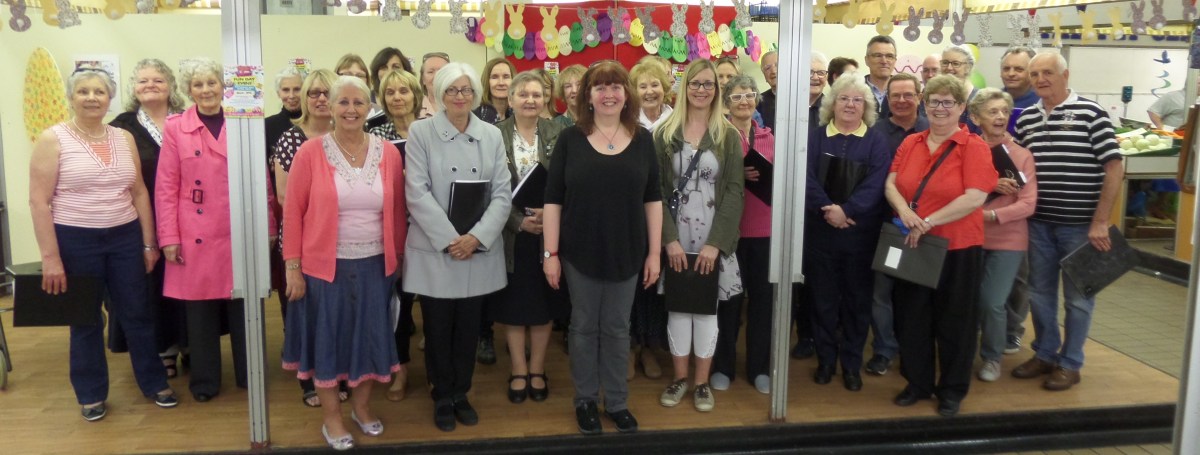
There is nothing like a good sing. All singers know this. They know that singing either solo or with others has enormous benefits. Thanks are due to Gareth Malone, whose popularising of the joys of choral singing has led to a remarkable renaissance in the UK and elsewhere of community choirs.
Having started a community choir in January, 2016 that is going from strength to strength, I have been humbled by what I have witnessed over the past year and a half. During the first few weeks, I was shocked by the numbers of people who told me they could not sing. It was the first thing many of them said as they walked through the door. What I found heartbreaking was that many of these people had been told at school, by teachers when they were six or seven years old that they couldn’t sing. They, of course, believed this and shut themselves down as singers at a tender age. How devastating. There are many things that six and seven year olds can’t do, or can’t do very well and that is because they are children and they are developing. What entitles anyone to tell a child they can’t do something, especially something like singing which is something everyone can do?
I firmly believe that everyone can sing; that everyone has a voice. It might not be a strong voice or a voice that can range very far or a voice that has great tonal variety. But a voice it is and it is everyone’s right to use it to the best of their individual ability to make music in the most accessible and democratic way of all. Our voice is our unique musical instrument. We carry it with us everywhere we go and it can be used in all sorts of exciting and unique ways to create music and to express ourselves.
What I have witnessed since the choir’s inception in January is a group of people, many of who initially lacked faith in themselves and their abilities, making a glorious sound, week in week out. They sing with passion, verve, humour and conviction and it is an honour to lead them in song. I am sure my experience is not unique and that it is a story replicated in many places where such choirs have sprung up in recent times.
Singing has so many proven benefits it should be available on prescription. It can help overcome anxiety, depression and insomnia. It can help overcome shyness and social anxiety as people get together and sing in groups, sharing in music making but not having to stand alone in the spotlight. Singing can help alleviate respiratory problems like asthma and can increase flow of oxygen to the blood vessels and brain. It is a joyful and invaluable enterprise that should only be encouraged.
As part of my practice I offer one-to-one and small group singing lessons. This singing for well being is designed to enable adults to find their voices and learn techniques to help them get the very best from their voice. My sessions are ideal for beginners and singers who wish to sing for joy rather than for public performance or exams. Click here to contact me on the website for more information.
Long may we sing and also may we get into the habit of not telling people that they can’t!
 The process of writing this collection began in the distant early spring of 2016 when Gill Wilde, promoter and director at Grimsby Jazz asked if I’d like to collaborate on a jazz and poetry project with Alan Barnes and Pat McCarthy in which we would use the heritage of fishing in Grimsby as inspiration. I was thrilled to be asked, not just because of my Grimsby origins and the fact that people here are 90% sea water and 10% east wind but because the story is a compelling and multi-faceted one. Furthermore, the opportunity to work with musicians of such outstanding calibre was not something I was going to miss.
Gill arranged a visit to the Grimsby Fishing Heritage Centre and a tour of The Ross Tiger, the trawler that stands in dock as a lasting testimonial to the astonishing fleet that made Grimsby one of the most significant fishing ports in the world at its heyday. It’s always made me sad how through my lifetime I have seen the docks decay and fall into disuse and disrepair. There is a wealth of history and heritage here that has been allowed to fall into nothing.
The tour of the centre and the trawler were impactful and I set about writing and produced the first draft of the poems very quickly. I like to write collections in this way as I can capture a mood and feeling and the work is always more cogent when it comes as a flurry. Refining, editing and revising is where the real work is done and that took longer and was exciting as the poems developed their form and shape.
The story of fishing in Grimsby is a bleak one. It was built on a corrupt system of apprenticing boys from orphanages and workhouses and exploiting their labour. It was dangerous and uncertain and loss of life was an occupational hazard. However, I didn’t want the poems to just be bleak and unrelenting – like the work itself. I sought ways of telling stories about fishing that had elements of awe, wonder and magic about them. This led me to explore superstition and myth and to some wonderful and mysterious findings. Two of the poems, Witches in Eggshells and The Fisherman and the Seal Woman are centred on myths and the influence it had on our seafaring community. I also looked to nature and the power of the elements. I was particularly unnerved by the power of the barfrost, the black frost that could sink ships rapidly. The poem Barfrost is an attempt at capturing the fear and danger it represented.
Once the poems were written I was able to wait, with considerable anticipation, to hear Pat and Alan’s music. I knew it would be brilliant and I knew the ensemble of musicians performing it would bring the whole work to life in a visceral way.
On May 18th, 2016, Gill and I were sitting in the Old Clee Club as the musicians warmed up and Alan gave his directions. I was trembling with excitement and when the first notes of the suite sounded, Gill and I yelped and leapt up. The air in the club danced and I was overwhelmed. What a sound. Alan’s arrangements were full of detail and movement. I could feel the sea as the music rose and swelled and then ebbed back.
During the premier performance that evening I was carried with the rhythms and tones of the octet and as I performed the poems I felt them fit the music, I felt my voice working to carry the mood and nuance of the suite. It was an astonishing experience and the rapturous response of the audience was as moving as it was surprising. As a poet I am used to reading to quiet and polite audiences, and I enjoy that, but this was something else entirely. It was the same at the Cleethorpes Jazz Festival and the euphoria I felt swept me away.
And so, what a thrill to be taking A Fish Tale on a national tour this year. We start in July in Hull and Grimsby and then take a leisurely national excursion with it until mid November. All dates plus information regarding tickets are here on the website with links to venues.
The book A Fish Tale is available to buy for £6.50 (including postage and packing) via the secure Paypal link (leave your address in the notes): paypal.me/msjosiemoon
The CD is available by following the link to Alan’s pages: http://www.alanbarnesjazz.com
Blackbird heralds dawn as light breaks.
Where his gentle wing abides
spring enters in as a protest
and his song sings of hope.
I had the pleasure of being invited to talk about poetry on Radio Humberside this week as part of the BBC’s shout out for short poems to be considered for inclusion in a City of Culture poetry installation later this year. Anyone can participate; simply write a poem of no more than four lines that says something about where you live. Write it on a postcard and drop it in one of the posting boxes either at the Radio Humberside office or at one of the libraries.
The poem I contributed, Ode To Joy, is at the beginning of this column. I had been listening to Beethoven’s Ninth Symphony and the magnificent fourth movement with the Ode to Joy and thinking about its significance as one of the most enduringly popular and moving classical compositions of all time.
In 1942 the Nazis attempted to appropriate the Ninth and the Ode to Joy’s unequivocal message of unity and brotherhood in a performance for Hitler’s birthday. This naturally tainted the piece for some time, but it was reclaimed in 1951 when it was conducted by Wilhelm Furtwängler at the Bayreuth music festival. Subsequently it was adopted as the anthem of the European Union in 1971 and has been performed at significant moments in history since. For instance, Leonard Bernstein conducted a performance of the Ninth when the Berlin Wall came down. The Ode to Joy continues to resist appropriation and be a resolutely optimistic work that truly celebrates universal values of love, unity and cooperation.
Inspired by Freidrich Schiller’s poem written in 1785 Beethoven takes the essence of the poem as inspiration for his symphony. It is a beautiful eulogy to the power of joy and of divine love. I was struck by the line in Schiller’s poem in which he references the sanctuary of heaven ‘where your gentle wing abides’ and its borrowed plumage well serves my own poem.
The song of the blackbird was my inspiration, as well as this wonderful moment in time, the spring equinox, when dark finally gives way to light and the days lengthen towards the summer. Listening to the blackbird singing in the early morning and hearing the pure notes of life affirming delight in its song, I am as uplifted as I am when I hear the Ninth Symphony. Both contain music that speaks directly to the soul and connect the oneness of the self to the embrace of the universe. In my poem I wanted to bring together Beethoven, Schiller, the blackbird and the idea that human connection, unity and shared optimism still matter. However dark the days might seem and however hard and cruel the world can appear to be, there is still a way to transcend darkness and to find solace and hope in the sublime; whether that is in the sublime beauty of Beethoven or in the morning song of the blackbird in your garden.
(First published in The Cleethorpes Chronicle, Thursday 23rd March 2017)

Handmaid’s Protest (Source: Planned Parenthood @pptxvotes)
The sight of women protesters in Texas dressed as Handmaids chills my blood. The photograph showing twelve women peacefully protesting surrounded by six armed men fills me with rage. This is Donald Trump’s America, a place in which thirty men gather in a closed room to talk about women’s reproductive and maternity rights in scenes reminiscent of the Saudi conference on women’s rights to which no women were invited.
When Margaret Atwood wrote her dystopian novel, The Handmaid’s Tale in 1985 she used precedent for every seemingly unimaginable scenario that she depicted. Some of those precedents were biblical, particularly the state’s ideological appropriation of the story of Rachel and Leah from the Old Testament but some were political and reflected practices seen in oppressive regimes such as Iran and Afghanistan where women had been pushed out of public life.
What is most troubling about The Handmaid’s Tale is not the reference to oppressive practice in countries such as Iran, Saudi Arabia, Afghanistan but the reference to oppression in societies and countries that claim to be democratic and to uphold women’s rights. Atwood’s forensic spotlight was very much trained on North America and the worrying anti-feminist trends that took flight in the 1980s and which have landed now with the ascendancy of Trump and his grotesque cast of misogynists undermining and destroying the progress that women have made towards emancipation and equality.
A man who sees no wrong in boasting of ‘grabbing (women) by the pussy’ will have no trouble in attacking women’s rights at work, at home and in the privacy of their own bodies. Right wing Republicans, particularly those of the Christian right have absolutely no problem with women’s health and their very lives being subject to the quite extraordinary whims of their distorted ideologies. Even a cursory search for comments made by such people about rape and domestic violence, let alone birth control and abortion yields a torrent of ill informed, deeply troubling polemic that would not seem out of place in the 1700s but which today is nothing short of abhorrent. ‘Legitimate rape’ in which a woman’s body ‘shuts down’ so as not to get pregnant was Todd Akin’s outrageous contribution to the debate on the right to abortion while he was running for public office. Although widely condemned, even by members of his own party he revoked the apology he felt compelled to make at the time and stands by his repellent views.
The anti-abortion lobby in the USA and increasingly in the UK hold to a particularly hard line on women’s reproductive rights, preferencing the rights of a fetus over that of a fully formed, living, breathing human being. Interestingly, these people are not so vocal about actual children living in extreme poverty or actual children suffering abuse, violence and neglect while making huge, moralistic claims about the right to life. If every life and every child mattered to these people they could do a great deal of good in the world by working tirelessly to eradicate child misery. Instead they choose to intimidate women and health professionals by standing outside clinics and interfering in people’s lives.
Reproduction is at the heart of Margaret Atwood’s novel. A major environmental incident has resulted in fertility being compromised. In true Old Testament spirit, women are deemed to be responsible for this and it is a crime to suggest men might be infertile. The handmaids are women reduced to the level of walking wombs. They are women seen as morally ‘unfit’ for anything other than breeding for the state. Some are divorcees, others activists, others unmarried mothers. Offred, the protagonist is an ‘unfit’ woman adjudged as being of low moral value. She is imprisoned by the state not knowing if her husband is alive or dead. Her beloved daughter has been confiscated and adopted by a family considered as ‘fit’ to raise a child. She is assigned a commander and his wife and her sole purpose is to become pregnant through the enactment of monthly state-sanctioned rape. If the handmaids do become pregnant there is no guarantee of their safety or any change in their status. They are subject to the whims of the commander’s wives who are allowed to hit them. Pregnant handmaids have been attacked by jealous wives. There are no guarantees that a healthy baby will be born at the end of a pregnancy due to the impact of the environmental disaster and successful pregnancies are rare. The births are grotesque spectacles with all handmaids in the district forced to attend, no pain relief or medical support for the mother except in cases of medical emergency and the ritual handing over of the baby to the wife immediately after birth with no care or attention to the birth mother.
The red garb of the handmaids and the white winged head dresses are designed for stigma and oppression. Red denotes their status as brood mares but also their stigmatisation as women whose former sexual behaviour marks them out as sinners, moral transgressors of the Puritanical mores of the state. The head dresses limit their field of vision and their capacity to engage with the world and with others. They are isolated and reviled. They are also subject to the control of other women, the terrifying Aunts in the Red Centre – collaborators with the state, the wives whose homes they live in and other handmaids. Each handmaid has a partner to walk with when they go shopping and they act as each other’s spy. The Nazis well understood the power of utilising women to police each other and this principle was central to the Nazi women’s movement in which some women could enjoy elevated positions without holding actual political power. The Aunts most closely resemble that historical model.
Offred’s story in the novel is horrifying and deeply human. In the Night sections she remembers her old life; her husband, daughter and the freedoms she enjoyed before Gilead. She also indicates the warning signs that were there, the prevalence of extreme right wing televangelists, the anti-feminist backlash, the incremental creep of the religious right towards power.
It’s not until we reach the end of the novel that we realise that Offred’s narrative is historical and is being presented as a conference paper many years post the fall of Gilead. Her fate is unknown. Our final glimpse of her is in her exit as she says ‘ And so I step up, into the darkness within; or else the light.’ We have to assume she escaped, at least for long enough to record her story for posterity and because we have spent a long and intimate time in her company we hope she made it to Canada and freedom but that speculation is both a triumph and a frustration of the text. We want a ‘happy ending’ for Offred but such an ending would have been both trite and insulting to the hundreds of thousands of people who have endured such regimes and who have not survived or who have survived but endured unspeakable damage and loss.
Offred’s story and that of others like her is in safe keeping with Professor Maryann Crescent Moon and Professor Piexoto. Professor Crescent Moon from the department of Caucasian Anthropology is an expert in Gilead studies, a keeper of women’s history, an expert, a woman free in her intellectual life post the apocalyptic dystopia of Gilead. The conference is an opportunity to re-examine Gilead historically and to understand Offred’s position as person trapped within it.
Sales of The Handmaid’s Tale have rocketed since Herr Drumpf marched into the Oval office and this week’s protests in Texas underline the anxiety that many women are facing in the USA now, today. These are dangerous times and Drumpf and his machinery of zealous oppression are a real and present threat, not just to women but to all who do not fit with his narrow, distorted view. This is a man who plans to scrap the Environmental Protection Agency, a man who denies climate change, a man who plans to end public subsidy for the arts and humanities, a man who plans to defund state education. The horrifying list goes on and on and in spite of brave attempts to stop him in his tracks he looks pretty unstoppable. When policies such as these gather traction and momentum then their outcome is almost inevitable. The USA is looking at much greater influence from the religious right, curtailment of women’s rights on a huge scale and an assault on the environment that could well be irreversible and catastrophic. It’s beginning to look a lot like Gilead.
Of course, America is not alone in its demented swing to the right. Here in the UK swingeing cuts to public services combined with an out and out assault on the poorest and most vulnerable in society have been the prevailing norm since 2010. We have an unelected Prime Minister claiming to be guided by Christian principles imposing austerity and failing to manage Brexit. Britain’s move towards isolationist, backwards looking politics should be concerning us all particularly as we will not have the protections of European law once we are cut adrift. There are MPs here longing to curtail women’s rights particularly with regard to abortion laws and we need to be vigilant. The tactical use of immigrants as distracting scapegoats is doing its job in keeping the focus away from what our draconian government is doing to civil liberties. It may not be long before Margaret Atwood’s frightening and prescient novel is as relevant here as it is in North America.
‘A Fish Tale’, the poetry collection is now available to buy as an attractive, limited edition pamphlet. Make your order via the secure Paypal link on the contact page.
 Josie Moon