Sunday 22nd February at Launde Abbey
At 3:50 this morning, the peace of Launde Abbey was shattered by the shrieking urgency of the fire alarm. Its insistent ‘get out, get out, get out,’ rhythm a jagged juxtaposition with the monastic stillness of this 12th-century sanctuary. For someone who has spent eight years living and working in the East Marsh dealing with the literal and metaphorical fires of managed decline, that sound was a trigger. It wasn’t just a noise, it was a physical invasion.
The second alarm at 5:50 brought with it the inevitable adrenaline hangover; that woozy nausea and the tightening around the sternum as if the ribs are bracing for a sudden punch. It’s the body’s automatic hyper-vigilance, a relic of our evolutionary past that doesn’t know the difference between a kitchen toaster and a marauding army.
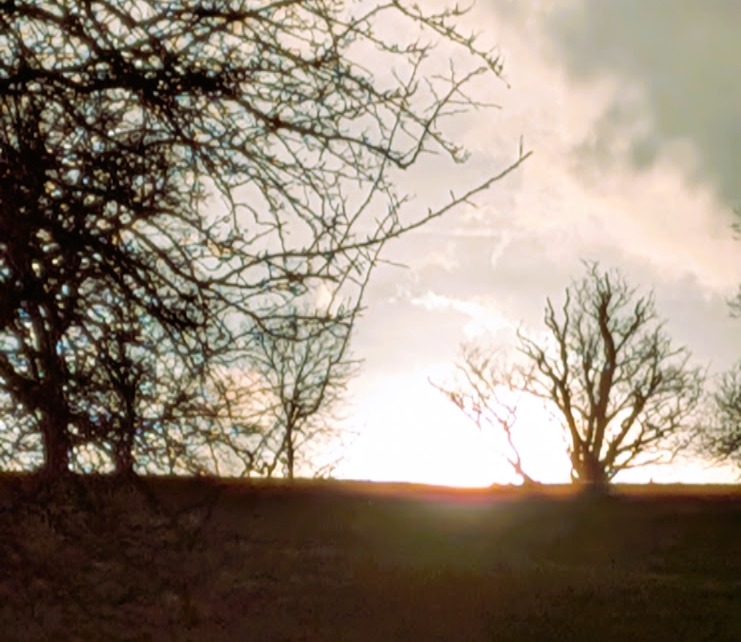
I made myself a cuppa, dog-tired but wired, watching the dark dissolve into a drizzly dawn with some hopeful streaks of gold in the sky. As a natural owl, I rarely witness the dawn, but the fire alarm redeemed itself by giving me the opportunity to get up and out and to see the dawn it resolve from grey to gold to spring blue.
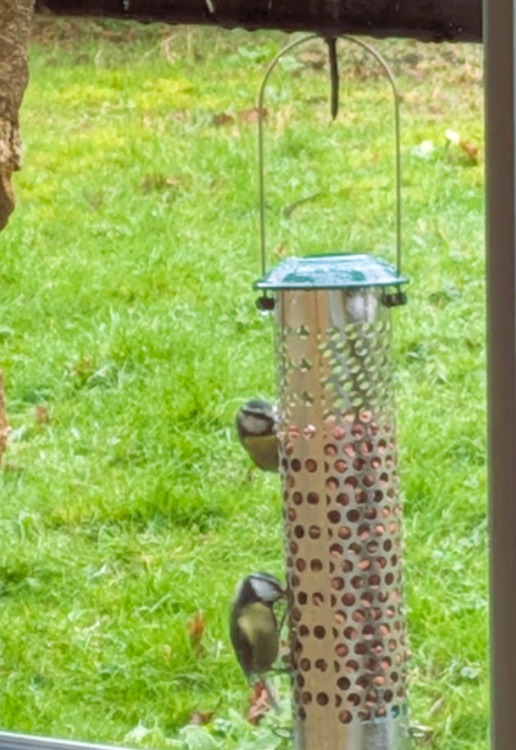
I went out to take a short walk to discharge the static in my nerves and to breathe the clean air of morning. I topped up the feeders, and the response was immediate. It was as if the entire Launde squirrel community and every blue tit in Leicestershire had been waiting for a sign. It was a bit like an invasion but there is a restorative power in watching a troupe of acrobatic squirrels and an army of blue tits. Their little blue caps and Zoro masks make me think of them as Resistance fighters. These are the more-than-human residents of this place, and they couldn’t care less about fire alarms and interrupted sleep, so long as the ‘hooman’ brings the goodies.
Watching them, I realised that this is the core of the struggle back home on the East Marsh. Our biggest problem isn’t just the broken bureaucracy or the class war, although these are real and brutal; it is our alienation from this engagement with the natural world, the loss of the healing, restorative relationship with nature is a wound we carry without even knowing its name. We are people severed from our place in the eco system and without that connection, we remain in a state of permanent, low-level alarm.
My reason for being here has been to dedicate deep time and focus to writing. For three weeks I have been wrestling with the material of the book like a person trying to pin down a shadow. The form of the book has been elusive, slipping away from me just as I thought I had it nailed. I was taking a too literal approach, an almost chronological “this happened, then that happened” account of the story of EMU. It was competent. It was alright but it lacked the breath of life. It wasn’t great, and it certainly wasn’t compelling. How we tell a story is just as important as the story we tell.
The realisation hit me on Friday, in conversation with Billy with more force than the fire alarm; I have been ignoring who I am as a writer. I am not a chronicler of incidents. I’m not a sociologist or a statistician. My creative heart sits in the Mundus Imaginalis, the imaginal world. My tools are myth, storytelling, Jungian archetypes, and the relationship with the natural environment. By sticking to the literal facts of the last eight years, I have been trying to describe a cathedral by counting its bricks, rather than feeling the space within its arches. The clarity came in my understanding that to tell the story of the East Marsh, I have to stop writing about a postcode and start writing about a human condition.
The struggle in Grimsby is a modern myth. It is the story of the Waste Land, a place of managed decline and post-industrial class war. It is a document of injustice that feels off the scale in height and depth and weight. But it is also a universal tale of human resilience. When we talk about the brokenness of the bureaucracy we live in, we are talking about the Broken King archetype of a system that has lost its way and no longer serves the land or the people.
By shifting into the mythic, I am not moving away from the truth;. I am moving deeper into it. This framework protects the material. It allows the particular circumstances of our lives on the Marsh to touch people who have never set foot in Lincolnshire. It gives the work a transcendent quality, turning a local history into a human map of alienation and the desperate, elusive search for restoration.
There is an irony in being a night owl, forced awake by a mechanical shriek, only to find the very light I have been searching for. For me the morning is often a blurred and bleary experience as I emerge from the owl persona. The 900-year-old sanctuary of Launde Abbey has acted as a temenos, a sacred, protected space where the noise of the world can be distilled into something meaningful. Even the rude interruption of the night served a purpose; it stripped away my defences and forced me to witness the dawn.
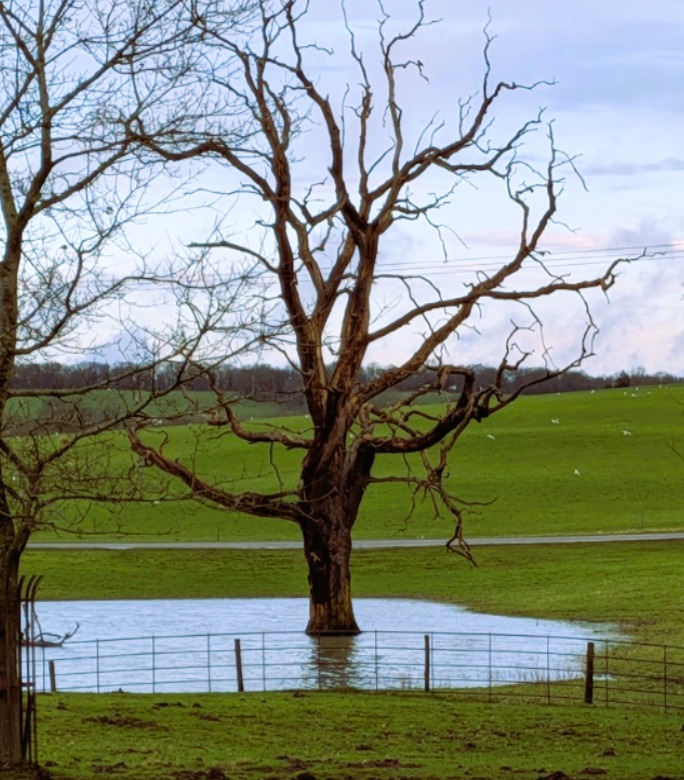
As I watched the light touch the trees, seeing the buds ready to burst and the tireless activity of the blue tits, I realised that my book is not just a document of a time and a place. It is an exploration of the soul’s relationship to its environment. The alienation we feel on the East Marsh is a microcosmic version of global pain, the disconnection from the natural world world that should be our greatest source of healing.
I have just five days left here before I return home. The landscape in front of me has changed. I am no longer just recording the class war or the managed decline through the lens of facts and events. I am writing from the Mundus Imaginalis, weaving the mythic into the story of the Marsh. The pain in my chest and the lingering tension in my head are the price paid for this shift in gear, the physical toll of a Revelation
The fire alarm was a false alarm. But the dawn? The dawn was real. And finally, so is the book.
As I watch the blue tits through the window as the afternoon light turns towards evening, I realise they are a metaphor for the East Marsh. We are small, we are masked by the labels society puts on us, and we are fighting for every scrap of feed in a landscape that is hard and often brutal. But like these birds, there is a transcendent energy in our survival. We aren’t just bit players in a post-industrial town; we are part of a much older, mythic story of resistance, persistence and transcendence.
And as if by magic, as I put the final touches to this writing a young dear appears on the lawn outside my window. We gaze at each other for a moment, and then she is gone.
 Josie Moon