
Autumn has arrived not in a season of mists, but in a blistering whirl of hard rain and hail, floods, and sultry warmth, bringing mosquitoes and blackflies. A warm spring and a hot, dry summer have left places like the East Marsh, which has been an urban heat island for months, with nowhere for the water to go. Rain has bounced moss and muck out of gutters onto the streets, adding to the ever-present mess of dog shit and litter.
In my back garden, the second flowering of gold roses—roses that are increasingly poignant for me—faced a battering. They opened their petals to rain so fast and ferocious they didn’t stand a chance. The day I was born, my grandma cut a small posy of gold roses from her garden and placed them beside my mum’s bed. Throughout my life, my mum has reminded me of this, and so gold roses are more than just flowers; they are a memory and an invisible thread that lightly ties the hands of my grandma, my mum, and me together.
On August 31st, I had one of my regular back-to-school dreams. In the dream I was due to go back to teaching, having taken a job I really didn’t want. The sense of dread was overwhelming as I bargained with the universe for just a few more days and wondered if I could simply not turn up. I left teaching in 2012, but I am still haunted by the ghosts of former classrooms and students. In my dreams, the places and the children I taught mingle into a blurry mess of anxiety and stress, of the wrong kids in the wrong school and me having no clue what I’m supposed to be doing.
The current education secretary has been urging parents to ensure their children go to school this term, following a huge increase in absenteeism. A sensible education secretary might ask difficult questions about why this is. But then they would have to face uncomfortable truths about school refusal: the links to poverty, the inadequacy of SEND support, the irrelevance of the curriculum to 21st-century life, the stress of the exams system, the cost of uniforms, and the idiotic rules about socks, speaking, and going to the toilet. No one would argue that education isn’t a critical factor in being able to reach your potential, but a system that too often stymies and stifles that potential is an underlying issue requiring attention. However, it is so much easier to blame parents who ‘can’t be arsed’ to get their kids to school.
In the wildness of this seasonal change and the surprise of these storms, the country finds itself battling for its identity. The flag of Saint George is flying everywhere. Following the recent rearrangement of the political deckchairs on the Titanic, the former Home Secretary—now Foreign Secretary—gave her permission for flags to be flown anywhere, claiming she “likes a good flag as well.” Starmer hastily put up some St George’s bunting to show his support for the huge spate of vandalism: ugly, red spray-painted crosses and racist graffiti on businesses and homes. The irony is sickening; this is the flag of St George, the patron saint of Palestine.

The flag of St George, so well beloved across many countries and cultures, should be the flag of everyone. While there have been well-intentioned attempts to reclaim it, that horse has bolted at least for now. It is clear to anyone who is honest exactly what this spate of flag flying is about: it is part and parcel of the anti-immigration rhetoric that is dividing communities and encouraging thuggery outside hotels and on the streets where racist abuse is increasingly commonplace.
Underneath all of this is a level of crisis and confusion being manipulated by cynical political games. We have the spectacle of Farage and Reform, unabashed in their peddling of hate, pretending to be on the side of the “everyman” while being a very lucrative business rather than a political party. Their MO is to fan the flames of division and hate, setting neighbourhoods alight with antagonism between neighbours.
We have the shame of overcrowded detention centres where traumatised people wait to have their asylum claims processed in a backlog caused by political failure to address immigration sensibly. We have the language of “swamps” and “swarms” to describe the myth of being overrun due to the deeply problematic small boats immigration route. In this tragic situation the only winners are criminal gangs exploiting vulnerable people and putting their lives at risk while the government does nothing to secure safe routes, nothing to counter false narratives and nothing to address the backlog in asylum claims.
All the while, the bourgeois political class pretends to be in full support of the flaggery, when we all know the only time they have previously entertained flags has been at The Last Night of the Proms or at public occasions that required a show of patriotism, such as a royal drive-past or a VE Day commemoration. The hypocrisy stinks and would be laughable if it weren’t so serious and damaging.
The flag of St George flag has a short history in terms of its most recent presence in English culture. It dates back to Euro ’96, when it became associated with football and specifically the England team. As Richard Herring noted in his 2010 podcast, https://www.bbc.co.uk/programmes/b00vhgc7 this is a relatively new association as he unpicks the short history of a flag that has now become so ubiquitous and synonymous with the hard right. Of course there is a much longer history than this but for the purposes of this conversation, its relative newness in the culture is interesting, particularly its progress from being a genuine symbol of English pride in the national football team to a threatening symbol of the hard right.
In the ’80s, the National Front appropriated the Union Flag. I remember seeing them in Newcastle on Saturday mornings, gathered around the Monument, sullen-faced in their uniforms of bomber jackets, jeans, and Doc Martens. They would hold up their magazine, Bulldog, and people would mostly avoid them. I remember a friendly copper telling me to cover my face because there were National Front photographers around during an Anti-Nazi League demo I attended in London. How times have changed. Today the police are under government orders to arrest peaceful protesters for holding up cardboard signs with words on them – particularly if they are elderly or disabled. Those who are standing in solidarity with the people of Palestine as they endure a live-streamed genocide are demonised while the government dismisses the insidious racism stalking our streets and manifesting in a sinister proliferation of the St George flag and cross as innocent patriotism.
So what does all of this flag-waving and graffiti actually mean? There is a strong case to be made that in post-industrial, disadvantaged communities, where poverty is high and opportunity is scarce, the flag has been grasped as a means of demonstrating power and resistance. When people have little or no power, are alienated and disenfranchised, then any chance to take power becomes attractive. The power to shout, intimidate, spray paint, and shake your fist is better than no power at all. Of course, these communities have been sold a fat lie: that the reason their lives are so difficult is because brown people on small boats are taking over their country. They are being encouraged by those with real power to punch down, to attack those who have even less than them.
While they’re busy punching down, they don’t have time to look at the real reasons for their multitudinous problems. The bourgeois political elites know this and use it to their advantage as they continue to asset-strip and manage the country’s decline. They prioritise the interests of capital and kleptocracy, the industrial military complex, and the corporations that rely on their nefarious behaviour to go unseen and unchecked. Our problems as a country are many and complex, ranging from the extortionate price of energy bills to the shit in our rivers and seas, from a mental health crisis in young people to a care crisis for our elders. Governments should be afraid of the people, but with increasing authoritarianism, surveillance, attempts to silence dissent and protest, and austerity measures that keep people economically oppressed, the government is ensuring that people are afraid of it.
The fight for the flag, overt racism, the demonisation of migrants, and the suppression of dissent are not new. Powerful elites have played these games many times, and it never ends well. History doesn’t repeat itself, but it does provide useful examples we could use intelligently to create a better present and fairer future.
There are many comparisons currently being made to the 1930s and the rise of Nazism and Fascism in Europe. While it’s useful to understand those events, they had their own context, which is not the same as now. Still, there are similarities. I see a similar sickness and decadence in our bourgeois political elites as existed in the Weimar period in Germany—a similar arrogant belief that you can fan the flames of civic discord without getting burnt. Newsflash: you can’t.
There is a similar self-indulgence and distance from the lives of citizens, and a sense of entitlement that the rules don’t apply if you hold the power. Every now and then, they throw one of their own under a bus. This week it’s Angela Rayner bearing the red mark of the scapegoat. She’s been caught out and her greed exposed, but she’s by no means the worst offender in the rotten political class. The scapegoat provides a useful breathing space where the attention is diverted and the light is shining brightly on the ‘bad apple.’ They will never turn the spotlight on the whole circus or take an honest look at just how decrepit and corrupt the entire system has become.
So, what the hell do we do about all this? How can citizens stand against hate, cynicism, and the moral decay of the government? There are no easy or quick answers.
Each of us lives on one miraculous planet that is supporting life in the vast loneliness of space. We each have one short life, and then we are enfolded in the great mystery of the eternal universe. Isn’t it a bit stupid, given that indisputable fact, that we would choose hate, division, corruption, and greed over love, community, honesty, and generosity? We do have an opportunity to choose the latter rather than the former in our immediate communities. We can choose to be good neighbours, build friendship, trust, kindness, and mutual support. We can find out why people are angry and afraid and have grown-up conversations about the real reasons that people are living difficult lives. We can come together and find common ground, focusing on the things that matter to all of us. This is not utopian idealism; this is the work that is happening across the country at a grassroots level right now. On an increasingly big scale, people are finding each other, sharing their knowledge, expertise, and understanding, and working hard to shift away from division and into solidarity.
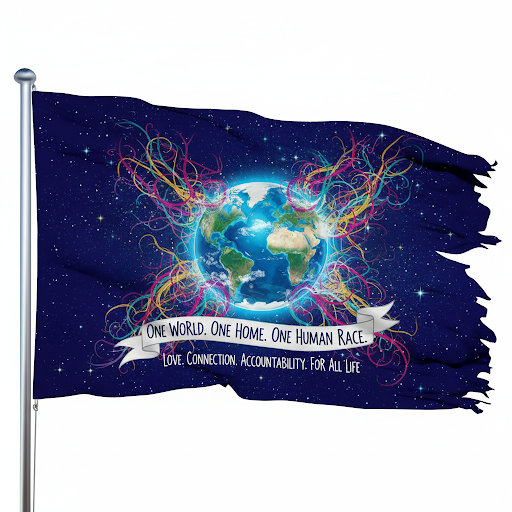
This is the work that truly matters, and it is the work that will most frighten elites and governments because it is beyond their reach, beyond their circles of power and influence. Not that they won’t try to co-opt and control it but we mustn’t let them. Our work is messy, organic, chaotic, and lovely. It is fierce, committed, and powered by love and compassion. If it had a flag, it would be an image of our blue planet against a background of stars, a reminder of what we all fundamentally share; one world, one home, one human race, and a plethora of more-than-human life in a beautifully connected ecosystem. If we can embrace connection and reject division, we have a real chance of healing the wounds inflicted on us by those whose interests it serves to have us at each other’s throats. Perhaps with that connection we have a greater chance of holding power to account and distributing it more equitably in the interests of all lives on Planet Earth.
 Josie Moon