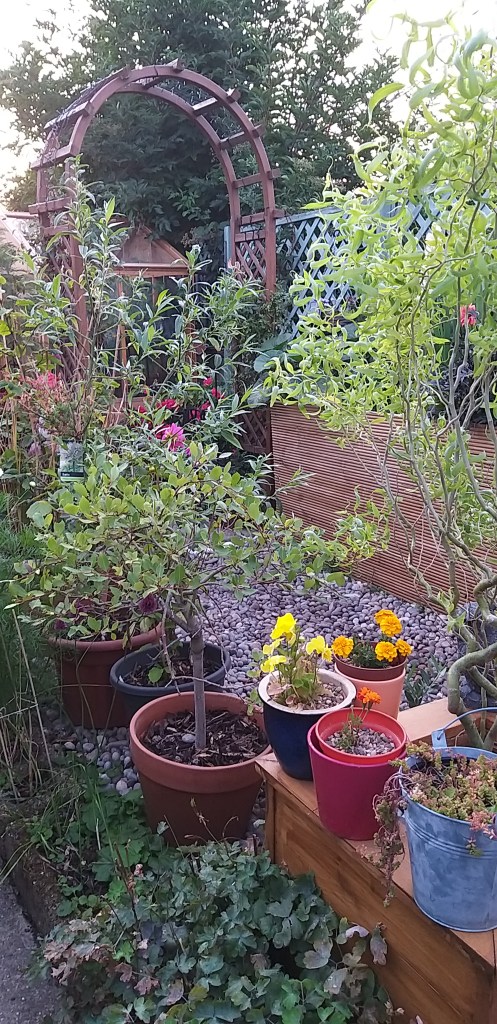
The mid-July rain is torrential now, drumming a relentless rhythm on the roof. Just a couple of hours ago, though, there was a brief reprieve, a window of calm that allowed me to step out into the garden. I spent that time deadheading, a quiet, repetitive task that brings a small sense of order, and potting on the baby strawberry sprouts, nurturing new life. Gardening, for me, is often a process of constant adjustment; I move things around until they settle into a place that feels right. My daylilies and agapanthus, despite being well-fed and watered, are showing no signs of flowering, so a move is on the cards for them. I also rescued my neighbour’s little boy’s tomato plant today, potting it into a much bigger container, pinching out the side shoots, and giving it a good feed. I’ll take it round to him when the rain finally eases.
Outside our front door, the street is a hard, concrete expanse with no greenery, and it’s running with water. We have no soakaways, no rain gardens, and the drains are Victorian. The threat of floodwater is very real. This stark reality, this vulnerability, has been a constant hum beneath the surface of the summer. The heat, too, has been oppressive. We’ve been fortunate to have invested in excellent sun blinds, and we’ve managed to keep the house cool by keeping windows closed, blinds down, and curtains drawn during the day, then opening everything up at night when the temperature drops. But the lack of canopy cover outside, the absence of trees to cast a natural shade, has been acutely felt.
This summer has been a period of profound challenge. I am still post-viral from a bout of COVID in June, and the fatigue of CFS and fibromyalgia has been relentless. On top of that, I’ve been dealing with bursitis and tendonitis, adding layers of physical pain and limitation. Yet, through it all, the garden has been my steadfast companion. Even on the really bad days, when I’ve felt utterly awful, it’s been there, a constant, quiet presence.
Beyond the physical, the garden has offered deep psychological support. The past few months have brought very difficult things to navigate, and those pressures are not easing. I have felt a sense of fragmentation, a deep pain about my parents and their struggles with failing health and chronic disease. As much as I am able, I support them, and I truly feel it is a privilege to be able to do that. This week brought a new shock: my sister’s sudden experience of a detached retina, emergency surgery, and the possibility of visual impairment. The whole family has rallied to support her, though she is not close by, and we can’t get to her just yet.
Illness this summer has also meant missing many important and lovely events at work. It has been a battle for me to let go, to simply take care of my health. It has felt, ridiculously, like a personal failure—a classic case of ‘Head Girl Syndrome,’ I suppose. But now, in mid-July, it’s time to change some plans, cancel a few things, and reorient myself. I need to prepare for the first breaths of autumn, which will come soon enough. The season of mists always announces itself to me through that most subtle change in smell and a softening of the light. I am not wishing summer away; it is a blessing and a pleasure. But there is something so delicate and melancholy about the first kiss of autumn, and I always look forward to it.
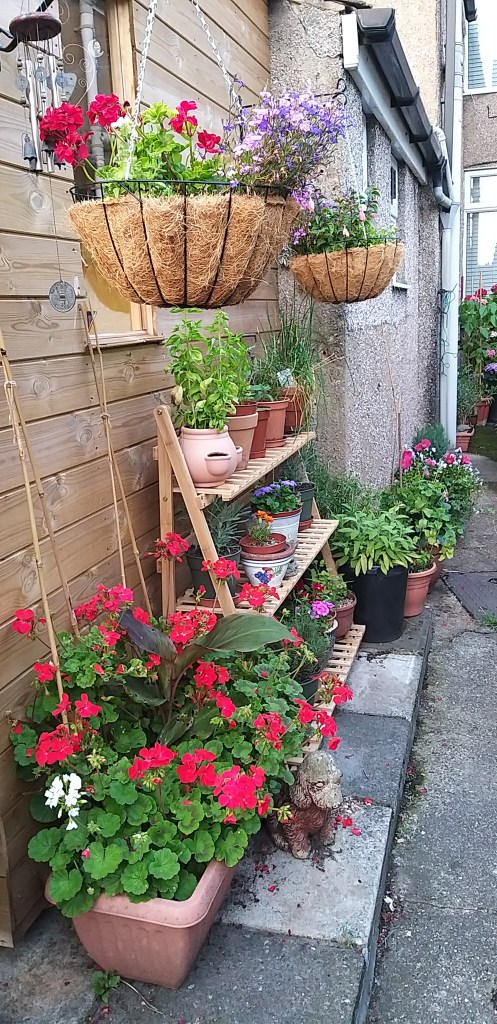
In this context, my garden is more than just a plot of land; it is an act of resistance. It stands as an example of what can be possible on a slum street. Its aspect makes it a very sunny garden, and being long and narrow, it’s like a corridor at the back of the house. It stands in stark contrast to the bleak frontage of our home and the surrounding area. Most of the gardens here are totally neglected and overgrown; there is no pride, no sense of connection with the environment. My garden, however, is a place of abundant growth and direct relationship with nature.
I am always delighted to see the bees and butterflies it attracts, to hear the birds. Our most prolific bird is the herring gull; they live on our rooftops and make a hell of a noise, but they are lovely and excellent parents to their young. The fledglings are now more or less all in flight, so there will be less squawking and dive-bombing for a while. I love to see them in flight; they have such grace. But I also love the little birds: sparrows, swallows, wrens, blackbirds, swifts, robins. There just aren’t that many here. We do have bats, though, and they are wonderful. They dance about at dusk, so fast and acrobatic.
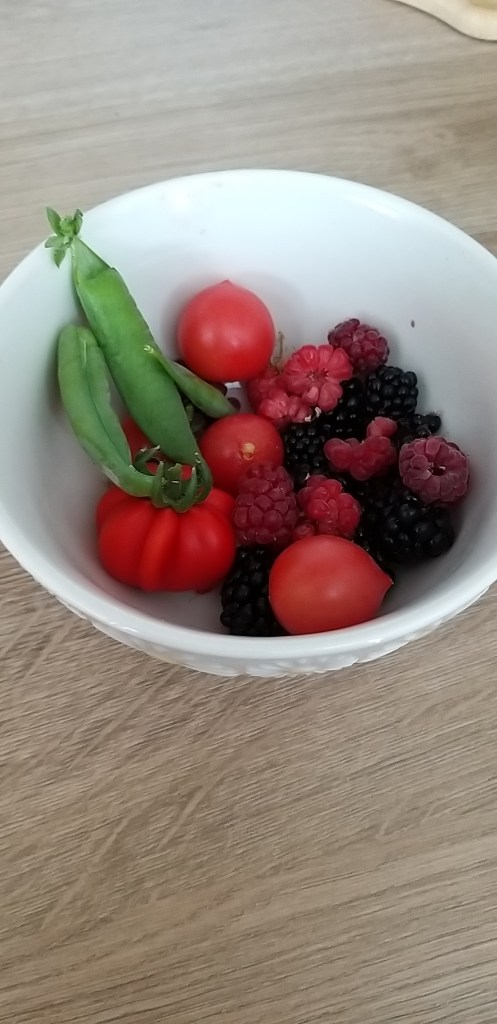
The garden’s produce has been a source of quiet joy. There were a few lovely strawberries, not many, but better tasting than anything I’ve bought in the shops this summer. My raspberries have been abundant and are reproducing new stalks; once they finish, I will move them to much bigger containers. Some of my tomatoes got bottom rot, but the rest seem fine and are turning red slowly—they are very tasty. Mini cucumbers are growing, I’ve had a few peas, and the beans are growing and should flower soon; they were a bit late going in. The one fruit I have put no effort into is the brambles: great, big succulent berries poking through from next door and in my own managed bramble corner. I have to be ruthless and do a lot of cutting back of brambles; they would take over if left to their own devices. I’ve had a few berries this week, and they are wonderful. I think there will be enough to go through to the autumn. Although, if Mr. Spugwell Brown, the very vocal house sparrow who has made his home in next door’s elder tree, runs out of elderberries, he may move on to the brambles—there are enough for us to share. In other parts of the garden, the hydrangeas are going strong, the hostas are flowering, and the sunflowers are ready to come into flower. The hollyhocks are leafy but have no flowers, and similarly, I have a cosmos bush with not many flowers. Despite these minor disappointments, the overall abundance is a comfort.
The troubling reality of the garden overheating on very hot days has solidified some plans. I had considered shade sails, but I think I am going to have a pergola built and plant a couple of fast-growing trees. A copper beech will provide dense, long-term shade, and a white lilac, which I just love, will add beauty and fragrance.
The concrete street and its water problems have also reinforced the need for better water management in my own space. Where the garden slopes, water pools, and this is where I envision a rain garden. It will help manage stormwater, allowing it to soak away naturally rather than contributing to street flooding.
Another significant change will be replacing the pebbles with a grass lawn. The grass died previously, leading to the pebbles, but I’m going to have some grass relaid. This will soften the garden’s appearance and, crucially, provide another soakaway. I plan for it to be a clover lawn, which will be wonderful for the bees. These changes, along with my new shed, greenhouse, and ‘growlery’ (my summer house built on the back of the house), are all part of making the garden more resilient and more deeply connected to the natural cycles.
In this summer of physical and emotional strain, the garden has been my anchor. It has been a space where I can engage in small, purposeful acts of nurturing, where I can witness the relentless, beautiful growth of nature, and where I can find moments of quiet joy amidst deep pain. It helps me to reset, to feel intact again, and to remember that even when human systems fail, and personal challenges feel overwhelming, there is still profound healing to be found in the earth, in the flight of a gull, or the dance of a bat at dusk. My garden is not just a garden; it is a testament to resilience, a small, vibrant act of resistance against the bleakness, and a constant source of solace.
 Josie Moon