This week, I’ve found myself in that peculiar and isolating place I’ve come to understand as the land of the unwell. It’s a territory, where the usual rhythms of life cease, and where I am left to navigate the profound impact of a body and mind in distress. For someone living with complex chronic conditions—fibromyalgia, chronic pain, chronic fatigue, and ADHD—this isn’t merely a temporary setback. This is a full-blown crash out, a period where the delicate balance of managing these conditions shatters, leaving me unable to cope with even the simplest demands. It’s as if my internal operating system has simply lifted the anchor, leaving me marooned.
The very nature of chronic illness is its ebb and flow, its unpredictable tides. Some days, it’s manageable, a familiar, irksome, companion. I can navigate the world, do my job and be a functioning adult. At other times, like this week, it’s an overwhelming force, stripping away all capability, leaving me feeling like a ship without a rudder in a particularly choppy sea. A recent day, in particular, felt like a battle lost, a day when the weight of it all pressed down relentlessly, leaving me flattened. The world outside, with its work responsibilities, its social expectations, its endless demands, became an insurmountable barrier. I’ve had to drop responsibilities, retreat from social contact, and contend with a mood that has plummeted to murky depths. It’s a strange, internal exile, a place where others, no matter how well-meaning, can’t truly follow. They can stand on the shore perhaps waving in sympathy, but the terrain within is mine alone to traverse.
Part of this profound exhaustion, I suspect, is the aftermath of a prolonged period of intense personal challenge. A significant life event, demanding immense emotional and practical heavy lifting—caregiving, running a home, maintaining a semblance of normalcy when everything felt anything but normal—has taken its toll. For many months, I ran on adrenaline, a high-octane fuel that kept me going, pushing through my fatigue and pain, the emotional strain. But now, that powerful surge has finally dissipated, leaving my adrenals depleted and my strength undermined. It’s as if the body, having fought the good fight, has decided enough is enough, and now demands its due. The constant backache and hip pain, usually a dull throb I’ve learned to live with, have sharpened into a relentless, all-consuming focus, forcing an undeniable retreat from the world. My body has staged a coup.
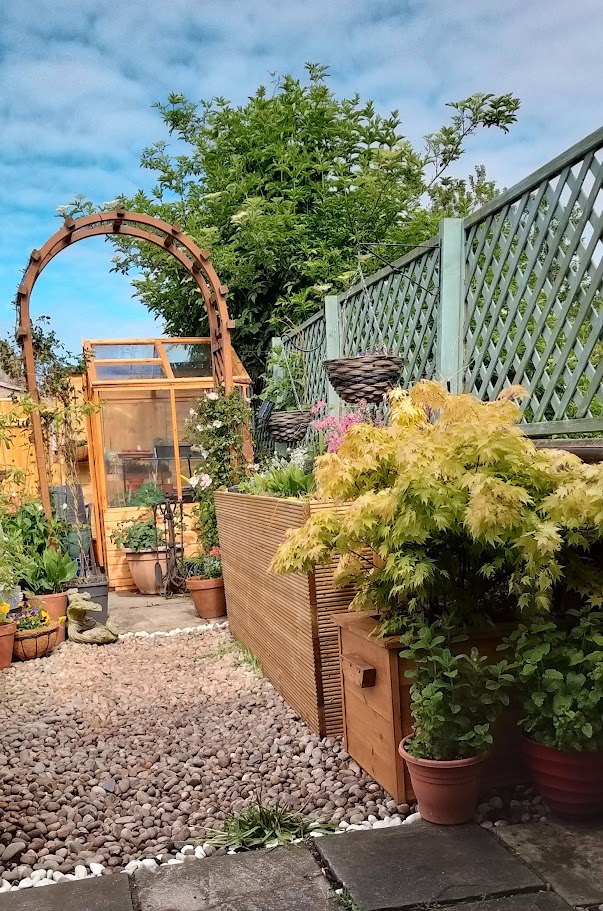
In this forced retreat, my garden has become both a sanctuary and, at times, a curious source of further physical strain. The joy it offers is immense, a deep, visceral connection to life and growth that no amount of internal turmoil can entirely extinguish. It’s a place where the plant life, the buzzing of bees and the earthy scent of damp soil, offer a grounding presence. Yet, the impulses of my ADHD often lead me astray within its embrace. I lose myself in time, that curious phenomenon where hours melt into minutes, pushing past my physical limits, as I did recently moving heavy, water-saturated hanging baskets. I knew, even as I was doing it, that I shouldn’t have. But there’s this obsessive drive to complete a task, a hyperfocus where everything else fades, and the immediate objective consumes all caution. It’s a peculiar paradox: the very thing that brings me solace can also, through my own reckless enthusiasm, exacerbate my physical woes.
Conversely, this same ADHD-driven intensity can manifest as deep paralysis. I have some lovely embroidery pieces, painstakingly crafted, that I want to wash, iron, board, and frame. The other day, I had them all laid out in front of me, a beautiful array of work And yet, I couldn’t do a thing. I just stared at them, my mind blank, thinking, “I don’t know what to do now.”That’s the overwhelm, taking control. By putting everything in front of myself, I create a mental blockade, unable to find a starting place. I’ve got better in the garden with this, thankfully. Now, I go out, do some deep breathing, and consciously think, OK what am I going to do first? I’m taking a much more logical approach, and crucially, I’m not beating myself up mentally if I can’t get everything done that I wanted to. The beauty of a garden is that it’s a lifetime’s work. It’s not an hour or two on a Tuesday afternoon. It is a profound commitment to deep ecology, and to being part of the garden, present in it with all its life, becoming at one with it. It’s a living, breathing testament to patience and persistence, qualities I often struggle to embody.
In this space of retreat, my thoughts have turned to the divine, particularly to matters of faith and spirituality. As a devout skeptic in terms of organised religion, I find myself contemplating the divine not in dogma or ancient texts, but in the tangible, living world around me. If God exists, surely She resides in gardens—in the rich, dark soil, the vibrant flora and fauna, the myriad creatures that inhabit it. A garden, shaped by human hands, feels like a piece of creative art in God’s image, a reflection of the symbolic Eden, a place of absolute connectivity, equality, equity, beauty, joy, and love that the human soul perpetually craves. It’s a primal yearning, etched deep within our collective consciousness.
I was thinking recently that the garden is a microcosm of existence. It demands patience, nurtures growth, and accepts decay as part of the cycle. It teaches me about resilience, about the quiet strength of a tiny seed pushing through hardened earth. It’s a constant, gentle reminder that even after the harshest winter, spring will always return. The colours, scents and textures; the velvety softness of rose petals, the sharp smell of tomatoes, the cool dampness of the soil beneath my fingers – all these sensory experiences ground me, pulling me back from the swirling chaos of my own mind. Here, in this patch of earth, I find a profound sense of peace, a connection to something ancient and enduring that transcends my immediate troubles. It’s a spirituality that doesn’t require grand pronouncements or ornate buildings, but simply presence and observation.
This belief was affirmed in a recent encounter on the street, a small moment that resonated with spiritual weight. My friend and I were moving pear trees from my garden to our local developing community garden. We had them in an unstable trolley, carefully attempting to move them along the street. As we trundled along, we met two young men, East Marsh lads with their Staffie dog. These are the kinds of individuals who are often overlooked, or shunned. They find community with each other in a world that hasn’t always shown them much love. And yet, they stopped, their faces lighting up, exclaiming with genuine pleasure, “Oh, how brilliant, look at those trees! Aren’t they great? I love trees, me, I think they’re great and we need trees!” In a barren street, where my own small front garden is confined to a hanging basket, a wall basket, and a window box because the door opens straight onto the street and pots often get stolen, this moment of shared appreciation for nature, for something beautiful and alive, felt significant. It was a testament to finding God, if there is a God, in the simplest, most human of connections, appreciating nature’s quiet grace in an unexpected place. It was a reminder that beauty and wonder can be found even in the most unlikely of settings, and that the human spirit, regardless of circumstance, yearns for connection to something greater than itself.
Letting go of those pear trees, which I had rescued from a neglected property and nurtured for a year, was a spiritual act in itself. I had watched them suffer, so I rescued them, looked after them, fed them, and cared for them. I always knew at heart that they weren’t truly mine, and their rightful place was in the ground, thriving in the community garden, where so much vital work is being done in partnership with our church and community. The joy of seeing them planted up, hoping they will flourish and contribute to our shared space, was immense. It’s a powerful reminder that even in the midst of personal turmoil, there are moments of spiritual release and connection, a letting go that brings its own kind of peace. It’s always hard for me to let go, especially when I’ve nurtured and loved something, but the joy I got from those trees moving to where they needed to be, where they can truly grow and thrive, was emancipatory. I’m so grateful that we have that space as part of our community’s development.
This “crash out” has been a harsh reminder of my vulnerabilities, a stark confrontation with the limits of my own resilience. It has also, however, offered unexpected clarity and moments of grace. It’s a difficult journey, this navigating of chronic illness and the relentless demands of life. Recent stressors, though now subsided, were a brutal reminder of past traumas, dealt with as best I could by disengaging from the source – a necessary act of self-preservation when already running on fumes. And then there are the ongoing responsibilities of family life to contend with. The complex dynamics of family caregiving, supporting loved ones through their own struggles adds another layer of challenge. For me, hypervigilance adds to the general anxiety I feel and impacts my wellbeing. The ongoing journey of understanding and managing my own mental health, including fluctuating moods, feels more pronounced than usual right now. Self care is so important and not always easy for me. The world is darkening, there is suffering and horror out there on a scale that feels impossible to comprehend and I have to be so careful to not give in to despair and to always look to the light.
In this difficult time, in the land of the unwell, there are gardens to tend, trees to plant, and unexpected connections that reaffirm the enduring beauty of life. The garden, my sanctuary, continues to be a place of faith, a living testament to growth and renewal. It reminds me that even when I feel utterly depleted, there is still life to be found, nurtured, and shared. It is a constant, gentle whisper that even in the deepest winter of the soul, spring will eventually arrive, bringing with it the promise of new beginnings and faith that all things pass and that is OK.
 Josie Moon