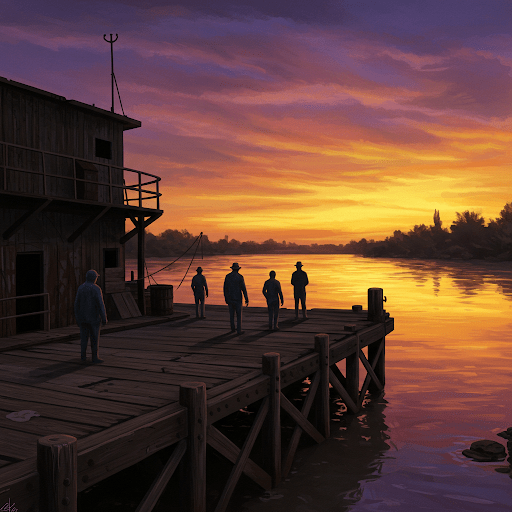
When you’re lost in the rain in Juarez and it’s Easter time too …
Just Like Tom Thumb’s Blues: Bob Dylan, Highway Sixty One, 1965
It’s a song that sits in my head very often, rattling around in fragments or in its full form. Last night, I sang it to myself in my head as I was falling asleep, seeing Dylan’s cinematic images of Mexico, the poverty and indifference to suffering, the exploitation and ennui. He gave up on Juarez and went back to New York. In my cold and blowy seaside retreat I know how lucky I am to have a break from ‘Juarez.’
My brain has been knitting together disparate thoughts about Easter and what is for me a peculiar time of year. The clocks have sprung forward and that febrile April energy is bubbling away. It’s like the world itself is in a state of flux, neither quite winter nor fully spring, and that uncertainty seems to seep into the mind, stirring up memories and half-formed thoughts.
This week, that mental cauldron has been particularly active, simmering with recollections of Easters past. When we were very little girls, me and my sister, there was an Easter when it snowed. . We were at Westfield Avenue then, the house where me and my first sister were born, in our small garden that felt enormous at the time. I remember shivering in the sudden cold and wanting to be inside, frozen and almost ungrateful for the opportunity to play in the snow so late in the year. It is poignant to look back at such a fleeting memory and be reminded now of the juxtaposition of spring’s promise and winter’s lingering chill.
My brain then took me to my second year at Newcastle Poly. The academic pressure was starting to ramp up because I was late with a piece of writing, an extended essay on Samuel Johnson’s History of Rasselas, a text I realised I didn’t have enough to say about and was wondering how to make it work. Amidst this my youngest sister was battling with her GCSE Shakespeare coursework, standing beside me with a hangdog face and begging me to deal with Macbeth. Of course I helped her, more than I should have done. We’d moved to Scartho Road by then, a house where the garden became Mum’s real passion. I can picture her out there, fag in hand, high heels on, coaxing life from the often-reluctant East Coast soil. Nana was with us that Easter, I think she might have been a bit under the weather. There was tension in the air, Mum perhaps feeling the strain, and the garden, usually a source of vibrant colour, seemed to mirror that subdued atmosphere, struggling against the persistent cold wind that’s so characteristic of our part of the world. That bitter bite, a constant reminder of our fishing heritage, the unforgiving North Sea shaping generations of Grimbarians.
Easter, of course, is a moveable feast, dictated by the lunar cycle, shifting its place between March and April. It’s always interesting to note which flowers mark the occasion. Sometimes it’s the bright trumpets of daffodils and the heady scent of hyacinths, other years it’s the more elegant sway of tulips and the first delicate bluebells pushing through the earth. Hyacinths always bring Auntie Helen to mind. Her birthday was in early March, and Mum would often buy her a pot of them, their vibrant colours a cheerful start to spring. I do love them, but indoors their perfume can become overwhelming and give me a headache. I only have them outside now, which they seem to like. The intense sweetness of hyacinths connects me to my ancient great aunts and lovely grandma, those dear ladies with their turban hats, delicate teacups, and the ever-present aroma of Nivea hand cream. I still use it sometimes, that familiar scent a tangible link to a bygone era. Again the poignancy and wistful sadness mingle with the pleasure of recall.
Easter holidays from school were, more often than not, a bit of a write-off in terms of actual revision, particularly in senior school. It was all about socialising, that desperate need to connect and feel part of something as adolescence took hold. University breaks, however, were a different matter. They were a welcome opportunity to come home, to indulge in nice food, Easter eggs, a comforting reminder of younger days. Mum was and still is a feeder and shared meals, not just at times of celebration were a huge part of my family life.
Sharing a room with my youngest sister during those breaks was alway interesting. She was meticulously tidy, her side of the room a shrine to Princess Diana and glossy Vogue models. Mine, on the other hand, was a chaotic landscape of books, clothes piled precariously, and, most memorably, a poster of a scantily clad David Lee Roth chained to a fence. She loathed it with a passion, which I found funny. She made it clear which half of the room was hers and which was mine. But our time of sharing a room forged an unbreakable bond between us which holds fast now.
Then came the Easter breaks during my twenty-four years as a teacher. Those were inevitably dominated by the relentless task of GCSE and A Level coursework marking. The promise of spring was often overshadowed by stacks of student essays and the pressure of deadlines. I was a much more conscientious teacher than I was a school student.
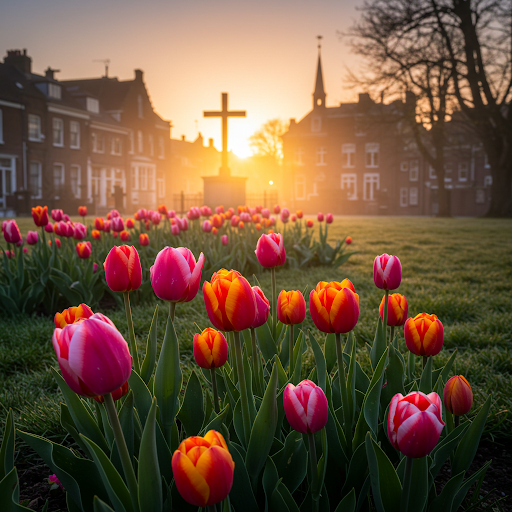
And what about now? Eastertime, whether it falls in March or April, feels like a precious part of the year. It’s when the light noticeably increases, stretching the days and lifting the spirits. Nature comes into her own with that glorious progression from the cheerful bursts of crocus to the elegant nodding heads of daffodils, the vibrant cups of tulips, the delicate haze of bluebells, the old-fashioned bleeding hearts, and finally, the first appearances of granny bonnets. It’s a visual feast, a tangible sign of renewal.
T.S. Eliot famously declared that “April is the cruellest month,” and there’s a certain truth to that. In these biting winds, juxtaposed with the lengthening days, the tantalising promises of sunshine constantly interrupted by sudden, sharp showers, the weather feels more capricious than truly cruel. It’s a month of false starts and fleeting warmth.
In the Easter Season itself, we have this fascinating layering of traditions. The ancient pagan celebrations of spring, of new life and fertility, were overlaid by the Christian observance of the Passion and Resurrection. And in turn, both have been subsumed by the relentless march of capitalism and its ubiquitous chocolate eggs. For the old world, this was a time of real significance, the stirring of life in the land, evident right now in the delicate white blossom of my pear trees and the emerging golden-red leaves of my acer in the East Marsh garden. For Christians, this period of reflection on sacrifice and salvation brings them closer to their faith. I remember a vicar friend of mine telling me that Christmas was pastoral while Easter was the true grit of the Christian Faith, a time to confront the viciousness of mankind and to reflect on the power of sacrifice and redemption. I am a devout sceptic when it comes to religion. I see God in a garden more than I do inside a church.
Another poem that always surfaces around this time is John Donne’s Good Friday, Riding Westward. Again, it takes me back to my second year at university, the discussions in seminar rooms sparking new ways of seeing the world. I was particularly struck by the idea of the soul’s orient being eastward, and the act of turning westward as a turning away from God and towards the material. As the West, in its current iteration, seems to be teetering on the edge of something resembling chaos, that particular line of thought feels surprisingly relevant.
Whatever Easter means to you, if you happen to be in a part of the world where it’s a significant time, I sincerely hope you manage to find a bit of rest and peace amidst the shifting weather and the various demands of life. Easter, in its own way, avoids the somewhat anticlimactic feel that often follows Christmas. Perhaps it’s the inherent optimism of spring, the undeniable increase in light and the burgeoning beauty of the flowers in the ground, that makes it a little easier to simply enjoy. There’s a sense of gentle renewal, a quiet promise that feels rather comforting. And if you have faith, may you be comforted by the resurrection and the enfolding love and compassion that Jesus, whether myth, man or Messiah truly stood for.
 Josie Moon